
Pyrolysis GC/MS screening (Py-GC/MS) is a powerful analytical method for the qualitative identification of the main organic components of complex materials such as leather, synthetic leather, and technical textiles. It is particularly useful for material characterization, comparative analysis, and the identification of unknown polymers or composite materials.
Principle of the method
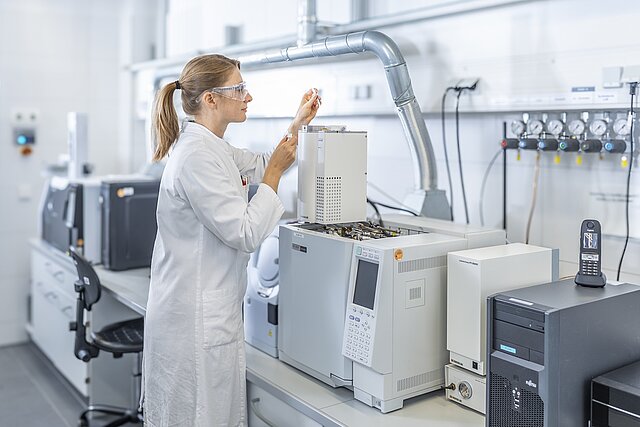
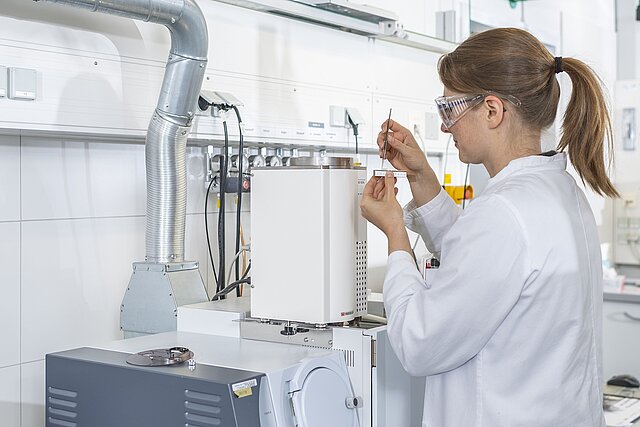
During pyrolysis, a small material sample (typically a few micrograms) is heated in an inert gas stream under controlled conditions – usually to temperatures between 500 and 700 °C. This thermally decomposes ("crackes") the macromolecular structures, producing smaller, volatile fragments. These decomposition products are then separated by gas chromatography (GC) and detected by mass spectrometry (MS).
Difference to thermal desorption
Thermal desorption GC/MS is suitable exclusively for the analysis of volatile and semi-volatile organic substances (e.g., plasticizers, residual monomers, solvents, additives).
Pyrolysis GC/MS, on the other hand, allows the investigation of non-volatile, high-molecular-weight material components through the thermal decomposition of the polymer matrix. This also allows the identification of the basic polymers or the main organic components of a material – regardless of whether they are natural, synthetic, or composite materials.
Application in leather and technical textiles
Leather: Identification of collagen as the main component, detection of coatings, resins, or synthetic binders in finishes.
Artificial leather: Differentiation of polymer matrices such as PVC, PU, PA, PET, or acrylates, including the carrier layer and top layer.
Technical textiles: Determination of the fiber types used (polyester, polyamide, polypropylene, etc.) as well as polymer or resin coatings.
Composite materials: Breakdown of multilayer structures (e.g., textile carrier + foam + film) through targeted sampling.
Presentation of results
The evaluation is carried out using characteristic pyrolysates and mass spectra, which are compared with reference databases.
Advantages
Determination of material composition even in unknown or multilayered materials
Fast and reliable identification of organic matrix components
Supplementary information on thermal desorption analysis
Small sample quantities required
Wide range of applications from research to quality assurance